Punch cards
When I first started selling cookies, my sales were pretty consistent but not growing very fast. On an average day, I would sell around 18 to 20 cookies, and while people enjoyed them, most customers only bought once and didn’t always come back. I wanted a way to motivate people to return, buy more than one cookie at a time, and feel excited about purchasing again. That’s when I decided to introduce punch cards as a loyalty reward system.
After selling cookies for a while I began to have consistent but not growing purchases. One day I would sell 20 cookies, the next I could sell about 30; although I had some frequent customers, most didn’t come back. I wanted to incorporate something new that would not only attract new customers, but would also make my current customers more loyal. This is when the punch card idea emerged.
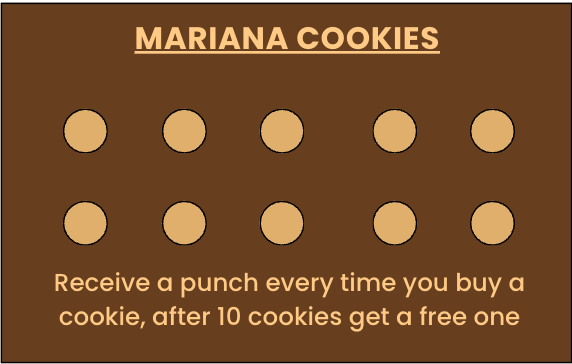
The idea was simple: every time you purchase a cookie you receive a punch, after ten purchases the customer would receive a free cookie. The day the punch cards were introduced I handed out 30 of them, this entailed that consumers had a reason to come back and purchase another cookie, which untimely made them look forward to it. Even though the free cookie is only received after 10 purchases, the system encourages customers to buy more cookies and become loyal customers instead of one time sales.
There is psychology behind the punch cards, they follow a goal-gradient effect, this encourages customers to become motivated as they get closer to their final goal: get a free cookie. As customers continue to fill up their cards, they become more likely to buy more cookies to fill their punch card faster, and buy extra cookies to fill it up. Customers get a sense of commitment once they begin filling up the cards, this means that they won’t waste a partially filled card. Moreover, loss aversion also plays a role in the punch cards, customers might feel like they are losing progress if they stopped buying before completing all 10 punches; even after the first punch they might begin to feel this sense of achievement which keeps them engaged with the product.
Results were not immediate after introducing the punch cards, but after a few days I began to notice changes. A few days after introducing them, cookie sales went up from 35 a day to 40, and have been stable ever since. I found that customers began to buy several cookies at a time, mentioning that this way, they could fill up their punch cards faster. Daily cookie sales grew a lot, which shows that the punch cards are working, and not only increasing sales but increasing loyal customers. Still, there are some days that sales did not increase, instead they decreased, these irregularities are usually because of time constraints: not enough time to make cookies or fewer customers.
I estimate that sales are going to keep steady as long as customers continue getting punch cards, this estimate is backed up by current data, and steady numbers for the past weeks. Overall, the punch cards were a successful and effective low-cost strategy that allowed them to increase cookie sales significantly, and turn sales from varied to stable selling out every day. By combining rewards and psychological motivation, the punch cards encouraged customers to buy more and stay loyal which effectively increased my sales; this study shows how a small change can have a great impact on customer behavior and product results.